Back to Hong Kong

Places You Shouldn't Miss on Your First Trip to Hong Kong

Published · 30 June 2026

Table of Contents

Introduction

Hong Kong is one of the most unique cities I've ever visited. Although it's part of China, its history has created a fascinating blend of Eastern traditions and Western influences that you notice almost everywhere. Towering skyscrapers stand next to traditional temples, historic trams pass through busy streets, and peaceful gardens offer a quiet escape from the city's fast pace. It's this contrast between old and new that makes Hong Kong feel unlike anywhere else.

In this guide, I've included the places I highly recommend to anyone planning their first trip to the city. You'll also find a map below with all the places mentioned in this guide, along with a few hotel recommendations.

I stayed at Novotel Century Hong Kong and found it to be a great base for exploring the city. Getting there from the airport was easy with a direct bus, and both the MTR and the tram were just a short walk away. One of the things that impressed me most about Hong Kong was how easy it was to get around thanks to its excellent public transport system.

Before you leave, don't miss the FAQ section at the end of this guide, where I've answered some of the most common questions about visiting Hong Kong.

This article may contain affiliate links, meaning I may earn a small commission at no extra cost to you if you book or purchase through them. Thank you for supporting and helping me continue creating travel guides and inspiration.

Google Map of Hong Kong


You'll find every place mentioned in this guide pinned on my Map, including cafés, restaurants and recommended hotels.

Open map in Google Maps to save places or download the map.

The Victoria Peak

I couldn't think of a better place to start this guide than Victoria Peak. It's one of Hong Kong's most famous landmarks and offers some of the best views over the city's skyline and Victoria Harbour.

Most people choose to take the Peak Tram to the top, but I'd actually recommend taking the bus instead. The journey up the mountain offers incredible views along the way, and it drops you off just a short walk from the tram's final stop.

The view over Hong Kong from the bus on the way up to Victoria Peak
The view from the bus on the way up to Victoria Peak

Once you arrive, you can either continue walking to the highest viewpoints or simply enjoy the scenery from the viewing areas. I decided to save my energy for the walk back down, and it was worth it 1000%. The whole route felt like walking through a tropical forest, and it ended up being one of my favourite experiences in Hong Kong.

Coffee from Bakehouse with a view of the Peak Tram in Hong Kong
Coffee at the Peak with a view of the tram
The forested walk back down from Victoria Peak in Hong Kong
The walk back down from Victoria Peak

Before heading back, take some time to explore the shopping centre at the Peak. There are plenty of cafés and shops, and it's actually where I found some of the best souvenirs to bring home.

Bakehouse

You simply can't leave Hong Kong without visiting Bakehouse at least once.

I originally went there for the famous egg tarts, but they weren't the only thing that impressed me. If you only try one more thing, make it the Beef Rendang Pie. Guilty! I went back three more times just for that pie.

A famous egg tart from Bakehouse in Hong Kong
Bakehouse's famous egg tart
The Beef Rendang Pie from Bakehouse in Hong Kong
The Beef Rendang Pie — worth going back for

If you're planning to visit Victoria Peak, there's also a Bakehouse inside the Peak Tower. Order your favourite coffee, have a seat outside or by the window, and enjoy the view over Hong Kong while watching the Peak Tram make its way up and down the mountain.

Monster Building

This is much more than just a photo spot.

The famous Monster Building (listed as Montane Mansion on Google Maps) is actually a residential complex made up of five connected buildings that's home to more than 10,000 people. It's only when you stand beneath these towering buildings that you truly understand how it got its name.

Looking up at the densely packed Monster Building in Hong Kong
Standing beneath the towering Monster Building

If you decide to visit, remember that people actually live here. Be respectful, keep the noise down, and follow any signs or rules around the building to respect the residents' privacy.

Choi Hung Estate Rooftop Basketball Court

This is probably the most colourful basketball court you'll ever see.

Surrounded by brightly coloured apartment buildings, it's become one of Hong Kong's most popular photo spots. Despite its popularity, it's still a functioning basketball court, so be respectful if people are playing when you visit.

The rooftop basketball court at Choi Hung Estate in Hong Kong
The rooftop basketball court at Choi Hung Estate
The colourful apartment buildings surrounding Choi Hung Estate basketball court
The colourful buildings surrounding the court

The basketball court is located on the rooftop of the car park, so don't worry if you can't find it straight away. I made the same mistake and spent a few minutes wondering where it was before realising I needed to head upstairs.

Getting there is easy, as it's just a short walk from Choi Hung MTR Station. Once you reach the rooftop, you'll understand why this place has become such a popular stop for photographers and travellers visiting Hong Kong.

Take a Ride on Hong Kong's Tram

Believe it or not, riding the tram is an attraction in itself.

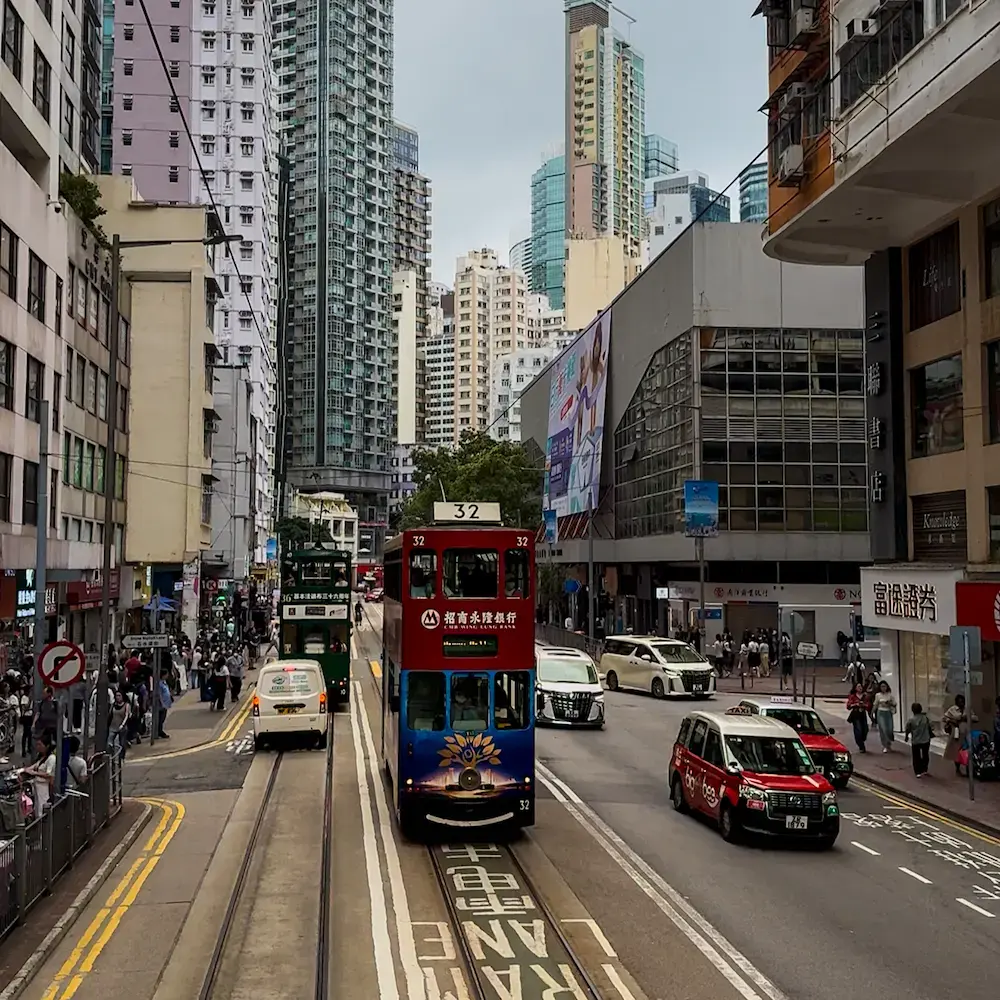
Hong Kong's iconic double-decker trams have been running since 1904 and are home to the world's largest fleet of double-decker trams. Taking a ride on one is an experience you shouldn't miss.

A Hong Kong street scene with double-decker trams
Hong Kong's busy tram-lined streets
An iconic Hong Kong double-decker tram
One of Hong Kong's iconic double-decker trams

My advice? Wait for a tram that isn't too crowded, head upstairs, and grab one of the front seats if you can. Watching the city pass by while trams travel just inches from each other is something that's hard to describe until you experience it yourself.

Hong Kong Park

Hong Kong Park is one of the most unique places to take photos in the city.

With waterfalls, ponds, lush gardens, and even an aviary, it feels like a peaceful escape from the busy streets of Hong Kong. What makes this park so special, though, is the contrast. As you walk through the greenery, towering skyscrapers suddenly appear in the background, creating a view that's hard to find anywhere else.

A lake in Hong Kong Park with the city skyline rising behind it
The lake at Hong Kong Park against the skyline
The Lippo Centre towers seen from Hong Kong Park
The Lippo Centre rising above the greenery

One thing I found fascinating is that Hong Kong isn't built on completely flat ground. Because of its hilly landscape, many of the city's skyscrapers stand at different elevations. Once you notice it, the skyline feels even more impressive and gives this park an even more unique backdrop.

Nan Lian Garden

If you'd like to experience a different side of Hong Kong, don't miss Nan Lian Garden. Built in the style of a classical Chinese garden, it's filled with peaceful ponds, traditional wooden pavilions, beautifully landscaped paths, and carefully shaped trees that make you forget you're in the middle of one of the world's busiest cities.

The classical Chinese landscaping of Nan Lian Garden in Hong Kong
The classical Chinese gardens of Nan Lian
The vegetarian restaurant hidden behind a waterfall at Nan Lian Garden
The restaurant hidden behind a waterfall

You'll also find a vegetarian restaurant hidden behind a waterfall. If you're planning to eat there, I'd recommend taking a few photos of the building before heading inside. It's one of the most beautiful spots in the garden. Since Chi Lin Nunnery is right next door, I'd definitely recommend visiting both at the same time.

Chi Lin Nunnery

Right next to Nan Lian Garden is Chi Lin Nunnery, one of the world's largest hand-built wooden Buddhist temple complexes, constructed without the use of a single nail.

From the moment you walk through the main entrance, you'll be surrounded by stunning traditional architecture, lotus ponds, and a sense of peace that's hard to put into words. As you explore the grounds, keep an eye out for the signs in certain areas where photography isn't allowed. It's important to respect both the rules and the people who come here to pray.

The main hall of Chi Lin Nunnery in Hong Kong
The main hall of Chi Lin Nunnery
The courtyard and lotus ponds at Chi Lin Nunnery in Hong Kong
The peaceful courtyard and lotus ponds

Out of all the places I visited during my trip to Asia, including Japan, this is the one that stayed with me the most. I've never experienced such a deep sense of calm anywhere else, and I genuinely hope it makes you feel the same way. If you ever visit, I'd love to hear what you thought of it.

Victoria Harbour & Bruce Lee Statue

No first trip to Hong Kong is complete without visiting Victoria Harbour and the Bruce Lee Statue.

This is one of the best places to admire Hong Kong's famous skyline, especially in the evening when the skyscrapers begin to light up. Take your time to walk along the waterfront, enjoy the atmosphere, and don't miss the Bruce Lee Statue, which pays tribute to one of Hong Kong's most iconic figures.

The Hong Kong skyline seen across Victoria Harbour
The Hong Kong skyline across Victoria Harbour

If your schedule allows, visit around sunset. Watching the skyline slowly light up as day turns into night is an experience that's hard to forget.

Where to Stay in Hong Kong

For most first-time visitors, Hong Kong Island and Kowloon are the two most convenient areas to stay. Both offer excellent public transport, plenty of restaurants, and easy access to many of the city's main attractions.

I personally stayed in Wan Chai, on Hong Kong Island, and I'd happily stay there again. It was easy to reach from the airport by direct bus, and both the MTR and the historic tram were just a short walk away, making it incredibly easy to explore the city.

To make planning a little easier, I've also pinned a few hotels on the interactive map at the beginning of this guide. They're all located in areas I'd consider for a future trip.

Luxury

Mid-range

Budget

FAQ

1. How Do You Get Around Hong Kong?

One of the things that impressed me most about Hong Kong was how easy it was to get around. The city has an excellent public transport system, and I never felt the need to use a taxi.

Most visitors choose to buy an Octopus Card, which can be used on the MTR, buses, trams, ferries, and even in some shops.

Personally, I used my phone with my Revolut card added to my mobile wallet throughout the entire trip. It worked perfectly on buses, trams, and the MTR. Just look for the contactless payment gates, tap your phone, and you're good to go.

One important thing to keep in mind if you're travelling with someone else: each person needs to use their own payment card or device. You can't tap the same phone twice for two different passengers.

Whether you choose an Octopus Card or contactless payments, getting around Hong Kong is incredibly easy. In fact, it's one of the best public transport systems I've ever used.

2. Do You Need Cash in Hong Kong?

The local currency is the Hong Kong Dollar (HKD).

I'd recommend carrying a small amount of cash, just in case, even though you'll probably use your card most of the time.

During my trip, I was able to pay by card almost everywhere, including on public transport. However, I did come across a few cafés, restaurants, and small local businesses that only accepted cash. There's no need to carry a large amount, but having a few Hong Kong dollars with you will make things much easier whenever card payments aren't available.

3. What is the Best Time to Visit Hong Kong?

Hong Kong is known for its high humidity, especially from late spring through summer, so if you're planning to spend a lot of time exploring the city on foot, I'd recommend visiting between October and December or March and April. These months usually offer the most comfortable temperatures and are much more enjoyable for sightseeing.

I visited in April and found the weather ideal for exploring the city. It was warm enough to spend the entire day outside without the intense heat and humidity that Hong Kong is known for later in the year.

4. How Many Days Do You Need in Hong Kong?

I'd absolutely recommend spending at least three full days in Hong Kong. That gives you enough time to visit the main attractions at a relaxed pace and really enjoy everything the city has to offer.

I made the mistake of underestimating just how beautiful and unique Hong Kong is, so I only planned to stay for two days. I still managed to see many of the places on my list, but looking back, one more day would have made the trip feel complete.

5. Is Hong Kong Safe?

From my personal experience, yes. Hong Kong is one of the safest cities I've ever visited, and I felt comfortable walking around both during the day and at night. The public transport is excellent, the streets are well lit, and I never found myself in a situation where I felt unsafe. Hong Kong is also widely regarded as having a very low rate of violent crime.

That said, it's always worth taking the same precautions you would in any major city. Keep an eye on your belongings in crowded areas, especially on public transport and in busy markets, and you'll most likely have a very enjoyable trip.

✦ Before you go

I hope this guide helps you plan an unforgettable first trip to Hong Kong. Take your time, explore beyond the obvious, and don't be surprised if the city ends up exceeding your expectations, just like it did mine.

If you have any questions that aren't covered in this guide, feel free to send me an email. I'll be happy to help if I can.

Have a wonderful trip!

Save this for later on Pinterest

Hong Kong travel guide — iconic views, food and local spots

Share this: