Back to Thailand

Things to Do in Bangkok (Your Ultimate Bangkok Guide)

Wat Arun seen from a boat on the Chao Phraya River in Bangkok
Wat Arun from the Chao Phraya River

Table of Contents

Introduction

Bangkok is chaotic, loud, busy and, at times, a little overwhelming. I still remember my first visit and how shocked I was by the chaos of the city. Honestly, I left thinking I would probably never come back. And yet, here I am, returning to Bangkok again and again, always finding new temples to visit, new neighborhoods to explore and little corners of the city I hadn’t discovered before.

The funny thing is that there are still so many other parts of Thailand I’d love to see, especially the north, but somehow, Bangkok keeps drawing me back. There’s always more to discover, and I guess that’s how I got caught in this Bangkok loop.

This article may contain affiliate links, meaning I may earn a small commission at no extra cost to you if you book or purchase through them. Thank you for supporting and helping me continue creating travel guides and inspiration.

The Bangkok skyline with the BTS Skytrain and JC Tower in the foreground
The Bangkok skyline

Important Things to Know Before Visiting Bangkok

Before diving into all the exciting things to do in Bangkok, make sure you read through these important tips. Knowing what to expect before your trip will help you avoid common travel surprises and make your time in Bangkok smoother and more enjoyable.

  • Bring Cash and Watch Out for ATM Fees

    Although cards are accepted in many places, cash is still useful in Bangkok, especially at street food stalls, local markets and smaller shops. I’d recommend bringing some cash with you or exchanging a small amount before your trip, so you have money available when you arrive.

    If you plan to withdraw Thai baht from ATMs, keep in mind that Thai banks charge a fee for foreign-card withdrawals, and your own bank may charge extra fees on top. Since the local fee applies to each withdrawal, it’s worth checking the amount displayed on the screen before confirming and avoiding lots of small withdrawals.

    And here’s one little thing to remember: don’t forget your card! This might sound obvious, but it has happened to me, too. Some ATMs return your cash before returning your card, and it’s surprisingly easy to grab your money and walk away while waiting for the card to come out.

  • Stay Hydrated in the Heat

    Bangkok can get extremely hot and humid, especially during the hotter months, and walking around sightseeing can be more exhausting than you might expect. Make sure you drink water regularly, take breaks throughout the day and step into an air-conditioned café or shopping mall when you need to cool down.

    Electrolytes can also be useful if you’re sweating heavily, particularly after spending long periods outdoors. Don’t underestimate the heat, and try not to squeeze too many outdoor activities into the hottest part of the day.

  • Wear Comfortable Shoes That Are Easy to Remove

    You’ll probably do a lot of walking in Bangkok, so comfortable shoes are a must. I’d also recommend wearing shoes or sandals that are easy to take off and put back on, as you’ll need to remove them before entering many temple buildings.

    This might seem like a small detail, but when you’re visiting several temples in one day, not having to struggle with your shoes every time makes things much easier.

  • Be Careful with Tap Water

    It’s best to stick to bottled or otherwise safely treated drinking water in Bangkok rather than drinking straight from the tap. If you prefer to be extra cautious, you can also use bottled water when brushing your teeth, especially if you have a sensitive stomach. Choose sealed bottles and avoid drinking water if you’re unsure whether it’s safe.

  • Bring a Face Mask for Air Pollution

    You’ll probably notice that many locals in Bangkok wear face masks, and during my first visit, I wondered why. I soon experienced just how bad the air pollution could get. The pollution levels were so high that I avoided going outside around midday and planned my days around early morning and late afternoon outings instead.

    I also remember that public transportation was made free for a week to encourage people to use the trains and buses instead of their own vehicles, as part of an effort to reduce PM2.5 pollution. This was a temporary measure introduced in January 2025, rather than a permanent policy.

    If you’re visiting Bangkok, I’d recommend checking the air quality during your stay and bringing a well-fitting N95 or KN95 mask for days when pollution levels are high. These masks help reduce exposure to fine particles. When air quality is poor, try to limit time outdoors and plan indoor activities instead.

  • Get an eSIM Before You Arrive

    One thing I’d recommend doing before your trip is setting up an eSIM. Personally, I use Airalo, and it’s been really convenient when traveling. Having mobile data as soon as you arrive makes it much easier to look up directions, get around the city, book a Grab, or find your way to your hotel without relying on airport Wi-Fi.

    I’d recommend setting up your eSIM before your flight, so you’re ready to go as soon as you land. Just make sure your phone supports eSIMs and check when your data plan becomes active.

  • Check Your Passport and Complete the Thailand Digital Arrival Card

    Before flying to Thailand, make sure your passport meets the entry requirements for your nationality. Some travelers need at least six months of passport validity remaining, so check the current rules before your trip rather than leaving it until the last minute.

    You’ll also need to complete the Thailand Digital Arrival Card (TDAC) before entering the country. It isn’t a visa; it’s an online arrival form required for foreign travelers entering Thailand. You can submit it within three days before your arrival, including your arrival date, through the official, free website: tdac.immigration.go.th.

    Make sure you use the official website, and remember that completing the TDAC doesn’t replace any visa requirements that may apply to you.

A giant guardian statue at Suvarnabhumi Airport in Bangkok
A giant guardian statue at Suvarnabhumi Airport

How to Get from the Airport to Bangkok

If you’re flying into Suvarnabhumi Airport (BKK), getting into central Bangkok is relatively easy, and you don’t necessarily need to take a taxi. The Airport Rail Link connects the airport to the city and is a convenient option, especially when traffic is heavy.

You’ll find the train station on B1, the basement level of the airport terminal. You can buy a ticket at the station before boarding, so there’s no need to arrange transport in advance. It’s still a good idea to have some Thai baht with you, just in case.

The Airport Rail Link connects with other train lines in the city, making it easy to continue your journey to your hotel. Just keep in mind that Suvarnabhumi and Don Mueang are two different airports, so check which one you’re arriving at before planning your transfer.

A long-tail boat on the Chao Phraya River with Wat Ratchanatdaram in the background in Bangkok
A boat on the Chao Phraya River

Getting Around Bangkok

Bangkok has several ways to get around, including the BTS Skytrain, the MRT subway, buses, taxis, tuk-tuks and boats along the river and canals. With traffic often getting quite heavy, I’d generally recommend using the trains whenever possible and taking a boat when it makes sense for your route.

BTS Skytrain and MRT

The BTS Skytrain runs above the streets, while the MRT is the city’s subway system. Both are useful for getting around Bangkok and avoiding traffic, but keep in mind that they operate separately, so tickets and payment methods aren’t always the same.

You can usually buy a single-journey ticket at the station before boarding. Depending on the system, you may receive a ticket card or a small plastic token. For the MRT, you tap the token at the entrance and return it through the slot at the exit gate. The BTS uses a different ticketing system, so follow the instructions at the station.

One thing worth knowing is that Bangkok’s public transport system works differently from what you may be used to in Europe. Don’t assume that one ticket or travel card will work across every network, and keep some cash handy for ticket machines that don’t accept your preferred payment method.

Boats Along the Chao Phraya River

Taking a boat is not only a lovely way to see Bangkok from the water, but it can also be a convenient way to get between certain attractions. For example, if you’re visiting Wat Pho and want to cross the river to Wat Arun, you can take a short ferry ride between the two sides.

Ticketing depends on the boat service. For some boats, you can buy your ticket at the pier, while on others you pay on board to the staff member collecting fares. Check the signs at the pier so you know which service you’re taking.

Buses

Personally, I wouldn’t make buses my first choice for getting around Bangkok. I tried using them on my first visit, and the bus I was waiting for never showed up. I gave them another try, but it wasn’t an experience I’d be keen to repeat.

Some buses are newer and more comfortable, but many are older, and routes and arrival times can be less straightforward for visitors to navigate. Buses can be useful for certain journeys, but for a short trip to Bangkok, I’d generally stick to the train network, boats, or a taxi when needed.

Grab

I’d recommend downloading the Grab app before your trip. It’s really convenient for getting to places that aren’t close to a train station, especially when you don’t want to deal with Bangkok’s traffic or figure out another way to get there. You can also use it to order food delivery straight to your hotel, which is handy after a long day of sightseeing.

A woman looking at the giant golden Buddha statue at Wat Paknam Phasi Charoen in Bangkok
The Big Buddha at Wat Paknam Phasi Charoen

Best Things to Do in Bangkok

1. Visit Bangkok’s Temples

If Bangkok doesn’t win you over on its own, its hundreds of temples certainly will. Every time I visit the city, I add new temples to my list that I want to explore. And having already visited more than ten during my last three trips, I can confidently say that each temple has its own unique beauty, history, and atmosphere. With around 450 Buddhist temples throughout the city, you could easily call Bangkok the “City of Temples.” From the grand temples found in its most iconic locations to the smaller, lesser-known ones tucked away in its neighborhoods, temples are an integral part of Bangkok’s identity.

Useful tip: The word “wat” means temple.

Wat Pho — Wat Pho is home to the famous giant Reclining Buddha, a 46-meter-long statue covered in gold leaf. It’s one of the temples I’d recommend adding to your Bangkok itinerary, especially if you’re visiting the city for the first time.

The golden Reclining Buddha statue at Wat Pho in Bangkok
The Reclining Buddha at Wat Pho

Wat Arun — Set along the Chao Phraya River, Wat Arun is known for its tall, beautifully decorated central tower. I’d recommend combining your visit with Wat Pho, as you can easily cross the river by ferry and visit both temples on the same day.

The ornate spire of Wat Arun temple in Bangkok
The central tower of Wat Arun

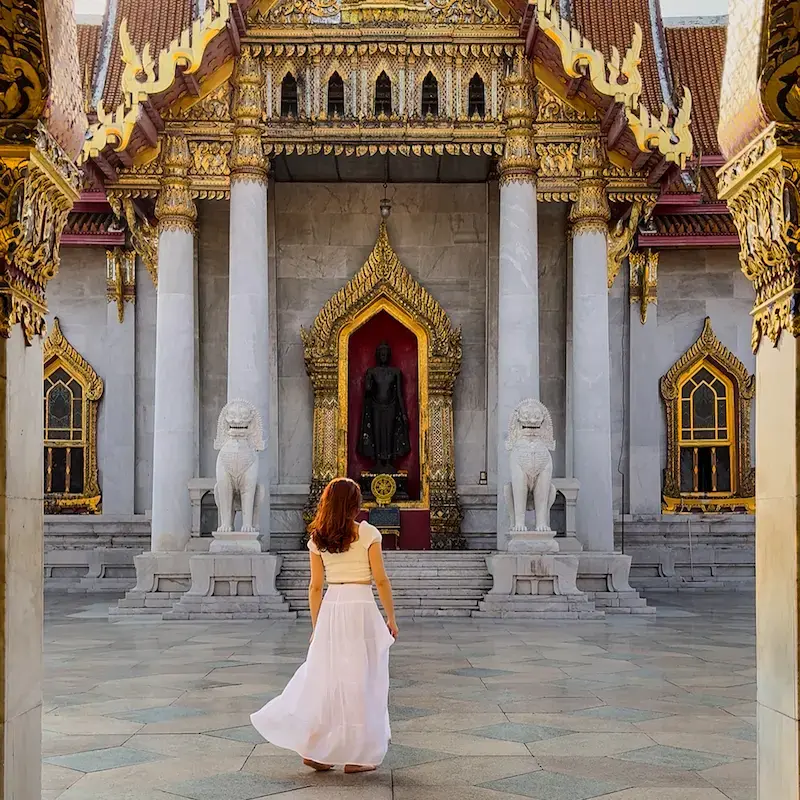
Wat Benchamabophit (The Marble Temple) — If you’re looking for a quieter temple to visit, I’d recommend Wat Benchamabophit. When I visited, I was actually the only person there, which made the experience even more special. It’s also one of the most photogenic temples in Bangkok, with its white marble architecture and beautiful details that make it stand out from the city’s other temples.

A woman standing before the ornate marble entrance of Wat Benchamabophit in Bangkok
Wat Benchamabophit, the Marble Temple

2. Try Local Thai Food

Trying traditional Thai dishes is a must when visiting Bangkok and one of my top recommendations. Khao Soi is one of my personal favorites: a creamy curry noodle soup topped with crispy noodles, traditionally associated with Northern Thailand. Pad Thai is another well-known Thai dish, a stir-fried noodle dish that’s popular throughout the country. And if you have a sweet tooth, don’t miss Mango Sticky Rice, a delicious dessert made with ripe mango, sticky rice, and coconut milk.

Naam 1608 — Naam 1608 is my favorite restaurant in Bangkok, and there’s no way I’d skip it on any of my visits to the city. Located right on the Chao Phraya River, it’s a lovely spot to enjoy traditional Thai food while watching the boats pass by and the sun set over the water.

I’d strongly recommend making a reservation, especially if you want a table with a river view around sunset. During my last visit, the second floor was closed, apparently for maintenance, which was disappointing because it had my favorite view. If you can, ask about the seating options when booking so you know what to expect.

The leafy entrance of Naam 1608 restaurant in Bangkok
The entrance of Naam 1608
Thai food and drinks on a table overlooking the Chao Phraya River at sunset at Naam 1608
Sunset views at Naam 1608

3. Discover Talat Noi

Colorful street art mural along a street in Talat Noi, Bangkok
Street art in Talat Noi

Talat Noi is one of those neighborhoods I love visiting whenever I return to Bangkok. I enjoy wandering through its narrow streets, spotting colorful graffiti and street art, and finding cute little corners along the way.

One of the most popular photo spots here is the old, rusty Fiat parked outside 32Bar X, a small shop specializing in Thai craft chocolate. You can stop by to try their chocolate drinks, although I have to admit that I wasn’t particularly impressed by the chocolate myself. If you enjoy taking photos, though, it’s worth stopping by to see the famous car that so many visitors come here to photograph.

An old rusty Fiat parked outside 32Bar X in Talat Noi, Bangkok
The famous rusty Fiat outside 32Bar X

4. Visit a Bangkok Park

Visiting one of Bangkok’s parks is a great way to take a break from the busy streets and see a different side of the city. Two parks I’d recommend adding to your itinerary are Lumphini Park and Benjakitti Park, as each has something different to offer.

A traditional pavilion by the lake at Lumphini Park in Bangkok
A pavilion by the lake at Lumphini Park
The lakeside path at Lumphini Park in Bangkok at sunset
The lakeside at Lumphini Park

Lumphini Park — Lumphini Park is probably my favorite of the two. It’s known for its large monitor lizards, which you can often spot near the lake, but there’s more to it than that. I visited in the late afternoon, and I still remember how the golden sunlight filtered through the trees, giving the park a lovely, almost romantic atmosphere. If you have time, I’d recommend visiting later in the day to enjoy the light and take a walk around the lake.

You might spot some of the park’s famous monitor lizards, too. They can look intimidating because of their size, but they generally avoid people and aren’t usually aggressive. They’re wild animals, though, so keep a respectful distance, never try to touch or feed them, and give them space to move away.

The skyline of Bangkok reflected in the lake at Benjakitti Park
Benjakitti Park, with the city skyline reflected in the lake

Benjakitti Park — If you’re looking for a park with great views of Bangkok’s skyline, I’d recommend Benjakitti Park. It has a large lake where you can capture beautiful reflections of the surrounding skyscrapers, which makes it a lovely spot for photography. The newer forest park also has elevated walkways that take you above the wetlands, offering a different view of the city. If you’re visiting in the late afternoon, the light reflecting off the water and the buildings can make for some really beautiful photos.

5. Explore Bangkok’s Shopping Malls

One thing I definitely wasn’t prepared for on my first visit to Bangkok was just how many shopping malls the city has, and how spectacular they are. I honestly don’t think I’ve seen shopping malls quite like these anywhere else. They’re huge, and many of them have their own unique character, so visiting them can be about much more than shopping.

The exterior of Terminal 21 shopping mall in Bangkok
Terminal 21 in Bangkok

Terminal 21 — Terminal 21 is one of my personal favorites. Each floor is inspired by a different city around the world, so you can go from one destination to another as you explore the mall. And if you enjoy going to the movies, I’d definitely recommend checking out the cinema here. I watched a movie there and had such a great experience that it ended up being one of my favorite parts of the visit.

The indoor waterfall at ICONSIAM shopping mall in Bangkok
The indoor waterfall at ICONSIAM

ICONSIAM — ICONSIAM is another mall I absolutely loved. It’s one of the most impressive shopping malls I’ve visited, with so much to see beyond the shops. One of its standout features is the indoor waterfall, and there’s also an outdoor terrace where you can step outside and enjoy views of the Chao Phraya River. Even if shopping isn’t really your thing, I’d still recommend visiting just to see the place for yourself.

6. Visit a Sky Bar

Bangkok's skyline at dusk seen from a rooftop bar
Bangkok's skyline at dusk

I’m not really a night person, and since I don’t drink alcohol, bars have never been places I’m particularly drawn to. But Bangkok changed my mind when it came to sky bars. The city looks so beautiful from above, especially around sunset, and visiting a rooftop bar turned out to be a much more memorable experience than I expected.

Some rooftop bars also host themed parties, complete with special dress codes, live music, and performances. I happened to visit Pastel Rooftop Bar during one of these events, with a blue-and-white theme, and there was even a show. It felt like a whole experience in itself, and honestly, it was on another level from what I’d expected.

A mocktail on a table overlooking the Bangkok skyline at Pastel Rooftop Bar
A mocktail with a view at Pastel Rooftop Bar

Pastel Rooftop Bar & Mediterranean Dining — Located on the 22nd floor of Aira Hotel, Pastel combines Mediterranean-inspired dining with skyline views and a lively atmosphere. If you’re thinking of visiting, I’d recommend checking their social media beforehand to see whether there’s a themed event during your stay. You might get to enjoy something a little different from the usual rooftop bar visit.

7. Take a Day Trip from Bangkok

Two of my top recommendations are Ancient City and the Sanctuary of Truth, as both offer something quite different from what you’ll find in Bangkok itself.

Ancient City (Muang Boran) — Ancient City is a huge open-air museum featuring replicas and reconstructions of temples, palaces, and other important landmarks from different parts of Thailand. The grounds are enormous, so there’s plenty to explore, and you can rent a golf cart to get around more easily.

When you arrive, you’ll receive a map to help you navigate the site and decide which places you want to visit. I’d recommend bringing sunscreen, a hat, and plenty of water, as you’ll be spending several hours outdoors. I visited around midday, and it was already very hot!

The Sanctuary of Truth — The Sanctuary of Truth is an impressive wooden structure in Pattaya, covered in intricate hand-carved sculptures. Almost every part of the building features elaborate wooden details, making it a fascinating place to explore and photograph. If you appreciate unique architecture and craftsmanship, I’d definitely recommend adding it to your list. Just keep in mind that it’s in Pattaya, so you’ll need to allow extra time for the journey from Bangkok.

8. Erawan Museum

If you’re looking for something a little different to add to your Bangkok itinerary, I’d recommend visiting the Erawan Museum. It’s best known for the enormous three-headed elephant sculpture on top of the building, which makes it stand out from the city’s more traditional temples. Inside, you’ll find colorful stained glass, intricate decorations, and beautifully designed interiors that are just as interesting to explore as the exterior. It’s also a great spot for photography if you enjoy visiting places with unique architecture.

One of the most popular spots to photograph the museum is from the 7-Eleven across the street, where you can capture the impressive three-headed elephant sculpture above the building.

The three-headed elephant sculpture above the entrance road at Erawan Museum in Bangkok
The three-headed elephant sculpture at Erawan Museum

9. Take a Night Cruise on the Chao Phraya River

One of the best ways to see Bangkok from a different perspective is to take a night cruise along the Chao Phraya River. As you sail past the city’s riverside landmarks, you’ll get to see places like Wat Arun illuminated after dark, creating a completely different atmosphere from visiting during the day. It’s also a lovely way to enjoy Bangkok’s skyline and take photos from the water.

Many cruises include a buffet dinner and live entertainment, making it an easy option for an evening out. If you’re planning to book one, I’d recommend checking what’s included and reading recent reviews, as the experience can vary depending on the boat you choose.

10. Explore Chinatown

If there’s one time I’d recommend visiting Bangkok’s Chinatown, it’s definitely in the evening. The streets look completely different once the neon signs light up, making it a great spot for photography. It’s also the perfect place to try some Thai-Chinese street food, with plenty of stalls and small restaurants to choose from. Even if you’re not planning to eat much, I’d still recommend going for a walk, taking in the atmosphere and enjoying the lively streets after dark.

11. Visit a Fairy-Tale Café or a Hidden Garden Restaurant

If you enjoy discovering cute cafés and unique places to eat, Bangkok has some lovely spots that are worth adding to your itinerary. From cafés inspired by storybooks to restaurants tucked away in lush gardens, these places offer something a little different from the usual city sightseeing.

A latte with a Little Prince design next to a star-shaped cookie at The Little Prince Café in Bangkok
A latte at The Little Prince Café

The Little Prince Café — The Little Prince Café is one of my favorite spots for a quiet coffee break in Bangkok. Inspired by the beloved storybook, it has a charming atmosphere that makes it a lovely place to slow down and enjoy a coffee away from the busy streets. Located in the Sathorn area, it’s a great little spot to add to your itinerary if you enjoy cute cafés with a unique concept.

The garden terrace and bar at Park Sathorn Restaurant in Bangkok
The garden terrace at Park Sathorn Restaurant

PARK SATHORN RESTAURANT — If you’re looking for somewhere that feels like a tropical escape in the middle of Bangkok, I’d recommend PARK SATHORN RESTAURANT. During my last visit, I loved its lush garden setting, complete with a pond, flowing water, and plenty of greenery. It almost felt like stepping into a hidden tropical oasis, and the food was just as impressive as the surroundings. It’s a great option if you want to enjoy a delicious meal somewhere that feels far removed from the city’s busy streets.

Where to Stay in Bangkok

Staying in a central area gives you easier access to Bangkok’s main attractions, shopping malls, restaurants, and public transportation. Siam and Ratchaprasong are convenient for shopping and sightseeing, while Phloen Chit offers an upscale setting with easy BTS access. Sukhumvit is a good option if you want plenty of restaurants and nightlife nearby.

Moxy Bangkok Ratchaprasong – Located right in the heart of Bangkok, opposite CentralWorld and within easy reach of Siam’s shopping malls. It also features a lively rooftop bar with skyline views.

Amara Bangkok Hotel – A comfortable hotel in the Silom area, with a rooftop infinity pool overlooking the city. It’s also within walking distance of BTS and MRT stations, making it convenient for getting around.

SO/ Bangkok – A stylish design hotel overlooking Lumphini Park, with distinctive interiors and an infinity pool offering impressive city views. It’s a great option if you’re looking for something a little different while staying close to the MRT.

The Okura Prestige Bangkok – A luxurious hotel in Phloen Chit, directly connected to the BTS Skytrain station. Its standout feature is the striking cantilevered swimming pool on the 25th floor.

Rosewood Bangkok – A luxury hotel known for its striking architecture, contemporary design, and details inspired by Thai culture. Its direct connection to Phloen Chit BTS makes it a convenient choice for a high-end stay.

The Siam – For a truly special stay, this exclusive riverside retreat offers lush gardens, art-filled interiors, and a peaceful atmosphere far removed from Bangkok’s busy streets. Complimentary shuttle boats connect guests to riverside attractions, making it an experience in itself.

Where to Eat in Bangkok

Naam 1608 – My favorite restaurant in Bangkok, serving traditional Thai food right by the Chao Phraya River. It’s the perfect spot to enjoy a meal while watching the boats pass by, especially around sunset.

PARK SATHORN RESTAURANT – A hidden garden oasis in the middle of Bangkok, with lush greenery, flowing water, and a peaceful atmosphere. The food is just as impressive as the setting.

Le Du Kaan – A rooftop restaurant on the 56th floor of The Empire, serving contemporary Thai cuisine with spectacular 360-degree views of Bangkok’s skyline. It’s a great choice for a special dinner with a view.

The Sixth – A small, cozy restaurant near Wat Pho, known for its Thai food and intimate atmosphere. It’s a convenient stop if you’re exploring Bangkok’s historic temples.

MITR STREET – A colorful, modern restaurant in the Tha Tien area, near Wat Pho, serving Thai-Chinese cuisine. Head up to its rooftop bar for views of Wat Pho and the Chao Phraya River.

FAQ

1. What is the best time to visit Bangkok?

The best time to visit Bangkok is generally from November to February, when the weather is cooler, less humid, and mostly dry, making it more comfortable to explore the city. March to May is much hotter, while the rainy season typically runs from May to October. Bangkok is a year-round destination, though, so you can still visit outside the peak season if you don’t mind the heat or occasional rain.

2. How many days do you need in Bangkok?

I’d recommend spending at least 3 full days in Bangkok to explore its main temples, discover different neighborhoods, try local food, and experience the city beyond its most famous attractions. If you have 4–5 days, you’ll have more time to explore at a relaxed pace or take a day trip outside the city.

3. Is Bangkok easy to get around?

Bangkok can feel overwhelming at first, especially because of its heavy traffic, but getting around becomes much easier once you know your options. The BTS Skytrain and MRT subway are great for avoiding traffic, while river boats and the Grab app are useful for reaching places that aren’t close to a train station. I’d recommend using public transportation whenever possible and allowing extra time for journeys by road.

4. Is Bangkok expensive to visit?

Bangkok can be surprisingly affordable, especially if you eat at local restaurants and street food stalls and use public transportation. At the same time, the city has plenty of upscale hotels, fine-dining restaurants, rooftop bars, and luxury shopping malls if you prefer a more luxurious trip. Your overall budget will depend largely on where you stay and how you choose to spend your time.

5. Is Bangkok safe for tourists?

Bangkok is a popular destination for tourists, but, as in any major city, it’s important to stay aware of your surroundings. Keep an eye on your belongings in crowded areas, use reputable transportation services, and be cautious of common tourist scams, especially offers that seem too good to be true. With sensible precautions, you can enjoy exploring the city while minimizing common travel risks.

6. What should you wear when visiting temples in Bangkok?

When visiting Bangkok’s temples, it’s important to dress respectfully. Choose clothing that covers your shoulders and knees, and avoid very short shorts, crop tops, or revealing outfits. Some temples have stricter dress codes than others, so it’s a good idea to carry a lightweight scarf or cover-up just in case. You’ll also need to remove your shoes before entering many temple buildings.

7. Do you need cash in Bangkok?

Yes, I’d recommend carrying some Thai baht with you, even though cards are accepted at many hotels, shopping malls, and larger restaurants. Cash is still useful for street food stalls, local markets, smaller shops, and some transportation services. You can withdraw money from ATMs throughout the city, but remember that local ATM fees may apply to foreign cards.

✦ Before you go

Maybe Bangkok isn’t the kind of city you fall in love with at first sight, but one thing is certain: you won’t run out of things to be amazed by. From centuries-old temples and vibrant street food scenes to spectacular shopping malls, rooftop bars, and hidden little gems tucked away in its neighborhoods, Bangkok brings together so many different worlds in one city. And that’s part of what makes it so fascinating: no matter what you enjoy, there’s always something waiting to surprise you.

Save this for later on Pinterest

Best things to do in Bangkok travel guide

Share this:

Continue Exploring Thailand